7. MPI Implementation
This chapter describes how PICLas subroutines and functions are parallelized.
7.1. General Remarks: Things to consider
In case any new communicator (e.g. SurfCOMM%COMM) is built during init or anywhere else with
CALL MPI_COMM_SPLIT(NEWCOMMUNICATOR,iERROR) or such, it is necessary to finalize it with CALL MPI_COMM_FREE(NEWCOMMUNICATOR,iERROR).
Else, load balancing will produce undefined errors that are almost impossible to find.
Debug MPI
mpirun --mca mpi_abort_print_stack 1 -np 3 ~/piclas/build/bin/piclas parameter.ini DSMC.ini
7.2. Construction of Halo Region (MPI 3.0 Shared Memory)
The general idea is to have the geometry information in a shared memory array on each node. This reduces the memory overhead and removes the need for halo regions between processors on the same node. An exemplary unstructured mesh is given in Fig. 7.12. The workflow is as follows:
Load the complete mesh into a shared memory window that is solely allocated by the compute-node root processor of size
1:nTotalElems(only node coords, not derived properties, such as metric terms).Load the elements that are assigned to processors on a single compute-node into an array of size
1:nSharedElems(red elements in Fig. 7.12).Find the compute-node halo elements and store in an array of size
1:nSharedHaloElems(blue elements in Fig. 7.12).Background mesh (BGM) reduction
Shared sides reduction
Halo communicator
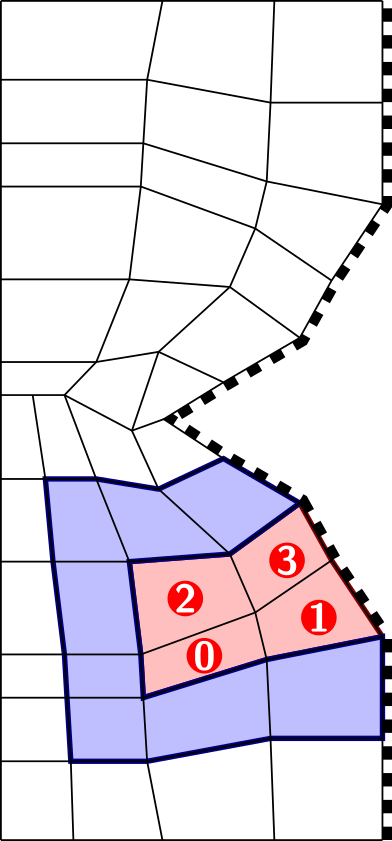
Fig. 7.12 Node local (red), halo (blue) and complete mesh (white). The red and blue geometry information is allocated once on each node and available to all processors on that node
7.2.1. Mesh Geometry
The complete mesh geometry is read-in by each compute-node and available through the ElemInfo_Shared, SideInfo_Shared, NodeInfo_Shared, NodeCoords_Shared arrays. Other derived variables and mappings (e.g. in MOD_Particle_Mesh_Vars) are usually only available on the compute-node.
7.2.1.1. ElemInfo
Element information is read-in and built in ReadMeshElems
ElemInfo_Shared(1:ELEMINFOSIZE,1:nGlobalElems)
! Possible preprocessor variables for first entry
! ElemInfo from mesh file
ELEM_TYPE         1    ! HOPR classification of element (currently not used)
ELEM_ZONE         2    ! Zone as defined in HOPR (currently not used)
ELEM_FIRSTSIDEIND 3    ! Index of the first side belonging to the element
ELEM_LASTSIDEIND  4    ! Index of the last side belonging to the element
ELEM_FIRSTNODEIND 5    ! Index of the first node belonging to the element
ELEM_LASTNODEIND  6    ! Index of the last node belonging to the element
! ElemInfo for shared array (only with MPI)
ELEM_RANK         7    ! Processor rank to which the element is assigned
ELEM_HALOFLAG     8    ! Element type:  1 = Regular element on compute node
                       !                2 = Halo element (non-periodic)
                       !                3 = Halo element (periodic)
7.2.1.2. SideInfo
Side information is read-in and built in ReadMeshSides
SideInfo_Shared(1:SIDEINFOSIZE+1,1:nNonUniqueGlobalSides)
! Possible preprocessor variables for first entry
SIDE_TYPE         1    ! HOPR classification of side
SIDE_ID           2    ! tbd
SIDE_NBELEMID     3    ! Neighbouring element ID
SIDE_FLIP         4    ! tbd
SIDE_BCID         5    ! Index of the boundary as given parameter.ini
SIDE_ELEMID       6    ! Element ID
SIDE_LOCALID      7    ! Local side ID
SIDE_NBSIDEID     8    ! Neighbouring side ID
SIDE_NBELEMTYPE   9    ! Neighbouring element type, 0 = No connection to another element
                       !                            1 = Neighbour element is on compute-node
                       !                            2 = Neighbour element is outside of compute node
7.2.1.3. NodeInfo
Node information is read-in and built in ReadMeshNodes
UniqueNodeID = NodeInfo_Shared(NonUniqueNodeID)
! Non-unique node coordinates per element
Coords(1:3) = NodeCoords_Shared(3,1:8*nGlobalElems)
7.2.2. Element/Side Mappings
To get the required element/side ID, utilize one of these functions from the module MOD_Mesh_Tools
! Global element
GlobalElemID = GetGlobalElemID(CNElemID)
! Compute-node element
CNElemID = GetCNElemID(GlobalElemID)
! Global side
GlobalSideID = GetGlobalSideID(CNSideID)
! Compute-node side
CNSideID = GetCNSideID(GlobalSideID)
If a loop is over the local number of elements, the compute-node and global element can be determined with the respective offsets.
DO iElem = 1, nElems
    CNElemID = iElem + offsetComputeNodeElem
    GlobalElemID = iElem + offsetElem
END DO
7.2.2.1. SurfSide
Additionally to conventional sides, mappings for the sides that belong to a boundary condition are available.
DO iSurfSide = 1,nComputeNodeSurfSides
  GlobalSideID = SurfSide2GlobalSide(SURF_SIDEID,iSurfSide)
END DO
7.2.3. Particle Element Mappings
PEM%GlobalElemID(iPart)         ! Global element ID
PEM%CNElemID(iPart)             ! Compute-node local element ID (GlobalElem2CNTotalElem(PEM%GlobalElemID(iPart)))
PEM%LocalElemID(iPart)          ! Core local element ID (PEM%GlobalElemID(iPart) - offsetElem)